Thursday, October 25, 2012

The debut


photo: Charles Stonewall

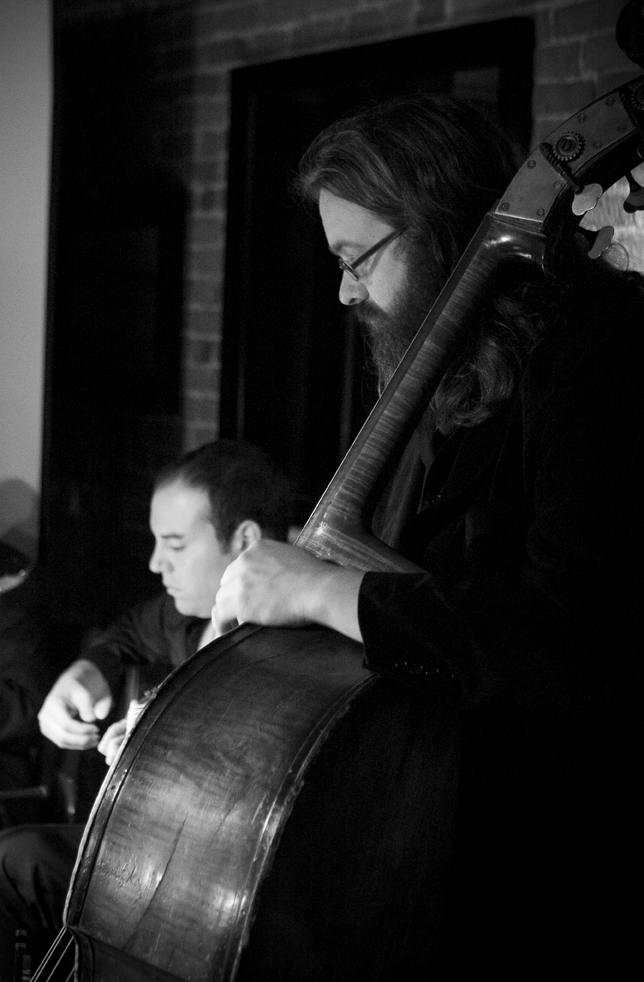
It’s now two weeks after our debut at Grünaer. –Success! - everyone really stepped up and gave it their all. I was amazed at the efforts people made to help us with this project. Shay’s family and friends were unbelievable. They came into the bar like a bee swarm and transformed the venue into a very convincing casa de fado. I think there must have been over two hundred candles.


photo: Charles Stonewall

Musically I couldn’t ask for more -highly prepared, solid performances of all sixteen songs. I personally didn’t feel the nervous jitters of a debut performance. I was more like a giddy little kid all day before the event (a rare occurrence indeed). I suspected that performing this music would be a very intimate situation but one could hear a pin drop in the room. The acoustic qualities of the room are just fantastic and the European vibe suited the music perfectly. We had around fifty people in attendance which is about all that room can handle comfortably. Apparently they drank well judging from the many empty wine glasses on the tables after the show.

photo: Charles Stonewall

During and before the two sets we projected images of Lisbon and famous fadistas behind us on a large screen. We also projected English translations in real-time during the performance of the songs. My wife Zhanna was gracious enough to practice this aspect of the show in advance and operate the computer during the performance. All for the price of two glasses of Spanish Grenache! Many in the audience were grateful for this aspect of the show.


photo: Charles Stonewall

We received many compliments and honest feedback from the knowledgeable patrons in the audience. My good friend Mary Posses (fantastic flutist) brought along UMKC professor of conducting, Steven Davis. He is a dedicated aficionado of fado and lived in Portugal. Steven was seemingly enamored with our presentation and very encouraging.

Honoring guitar maker, Dave Bucher, photo: Charles Stonewall

KCUR (89.3 fm) was there to document and record the process for a future segment dedicated to our project. They sent out one of my favorite photographers Julie Denesha to photograph. Julie is a really brilliant artist and I’ve been following her work with the Roma for many years.  http://www.juliedenesha.com/

 photo: Charles Stonewall

Our good friend and amazing artist Charles Stonewall was also there to photograph. Charles is known for his work in the dance community and is participating in Artist INC II with Shay (The photographs in this post are his work). http://www.charlesstonewall.com/

The following Sunday we had a private performance at The Ship. Jori Sackin shot video and Giuliano Mingucci recorded the audio. Hopefully we’ll be posting these work samples in a few days. 

- Beau

Thursday, September 6, 2012

Thoughts On Our Second Rehearsal - Shay Estes

     There was a beautiful and very humbling moment for me at our most recent Fado Novato rehearsal when we each spontaneously confessed to each other that we are out of our comfort zones on this project.  Jordan, who has played mostly pop and jazz music in his career, is delving into the patient art of the fado accompanist.  He must now hold the ensemble together like an anchor.  This requires perfect time, consistency, sensitivity, and subtlety.  He must be always aware of the soloists' needs for consistency in one moment and then tension or fluidity in the next.  He must add color and texture to the music without distracting from the soloist.  This role is not always the most exciting to play in an ensemble but it is the foundation on which everything else is laid.  In fado, this anchor is the 6-string guitar or viola, and it is the beating heart of the music.  Having long enjoyed the freedom of jazz improvisation and the carefree nature of various kinds of pop music, Jordan is now diligently attending this new, unfamiliar role.
     Beau, while no stranger to soloing on many instruments, finds himself usually more comfortable in Jordan's present role with his present instrument.  He is a classical guitarist first and foremost.  Sure, he is proficient in a multitude of stringed instruments, but he has only been working with his new guitarra for a few weeks.  It is strung and tuned very differently from the 6-string guitar.  It takes him one day for every new tune he must transcribe and work into his fingers.  He confessed that he has cleared much of his schedule and is working on little else leading up to our debut.  While fado is so similar in certain respects to many other styles he plays, the music and the instrument are still quite foreign. 
     For my own part, the differences between what I have done as a  vocalist up to this point and what I am learning now are not just altering the way I use my instrument: they are physically altering my voice.  The Portuguese language is very nasal,* which places a lot of the resonance in the mask of the face.  Fadistas rarely allow their voices to move into the falsetto register, which keeps the bulk of their vocalization in the modal range and resonates heavily and fully in the vocal chords.  An additionally challenging factor is that the key of any given composition is occasionally limited by the respective musical ranges of the guitarra and the viola.
     Finally,  fado lends itself well to natural vibrato.  I have spent most of my life as a vocalist - particularly the last eight years singing jazz - doing exactly the opposite of everything I just mentioned.  I have sung mostly in English, which as a result of the phonetics of the language causes resonance in very different places at very different times than Portuguese, which puts resonance in the nose, the sinuses, the front of the mouth and the forehead.  Through my training in jazz and previously in classical voice, I was taught to develop my falsetto and to suppress and control my vibrato to create bright, clear tones.  It was particularly a big "no-no" to push one's voice too high in the modal range; repeated violent resonance in the vocal chords can cause nodules, a career-ender for many a singer.  A great way to avoid those pesky range problems is always to change the key into something more suitable for one's vocal register.  After all, the piano player has eight octaves to work with!  What does he care?
     The effects of these efforts have been interesting.  As rehearsals commenced and I really dug deeply into our chosen tunes, I began to use my voice much of the time in a way to which I was unaccustomed and untrained, in a language I barely knew, on melodies I was very unsure of, in a part of my range that was weak, with a vibrato I had been holding back for years.  Sound began resonating heavily in my nose, forehead, and throat, with my voice pushing at questionable pitches in the top of my modal range and vibrating them like mad.  As I found out, this will give you headache.  A big headache.  A lot of big headaches.  It will also make your throat sore and horse.  I started to feel guilty about what I was doing to my instrument.  I needed to back off.
     I am not used to learning things slowly, especially not music.  Conquering a lot of Brazilian music took time initially because of the language, but much of it is very musically adaptable.  Within two months of diving deeply in I was digesting it at my usual pace.  To date, nothing has ever gotten me stuck as much as fado, not for the musical difficulty of it but for the sheer physical challenge.  I listen to these fadistas belt out their souls, and I marvel at their strength and endurance like a couch potato watching Michael Phelps win his umpteenth gold medal.  My feelings of doubt and insecurity (and a heaping workload from a few other projects I gleefully prioritized over my fado homework) lead me into Wednesday's rehearsal feeling sheepish and uncharacteristically unprepared.
     Then, a very funny thing happened.  At rehearsal, I listened as two musicians I know to be some of the most talented and hard-working guys in town told me how challenging this has been for them.  I perceive that music comes to these men as easily as breathing, and they confessed their similar frustrations and insecurities.  I realized that I allowed myself to miss the point:  The process is the point.  I am supposed to fail before I can succeed.  I am not going to be Ana Moura overnight.  If I am going to train my voice to do this correctly I must start slowly, just as Mr. Couch Potato probably needs to start with just a few laps a day at the community center before he tries to qualify for Rio in 2016.  I will sound a little awkward at first, but if I keep working at it a little every day I will get better.  No more headaches, no more sore throats.  Baby steps to Lisbon.  I confessed my lack of preparation to the guys, and they were kind to me.
     The good news is that after some rest, I can feel my voice has changed.  My range is broadening and my lower tones are richer and fuller with better pitch and more strength.  I am straining less at the top of my modal range, and the overlap between my modal and falsetto is slowly increasing.  I was worried that too much focused time spent on belting would weaken my falsetto as well, but as it turns out (and some research supports this as happening fairly often) it may actually be strengthening it.  Like any other muscle, I cannot max it out every day like I had been, but the heavy lifting is making it stronger.  Now, to get myself a good trainer.  I wonder if Carminho is taking students...

--Shay

 *By "nasal" I mean that that the Portuguese language contains a greater number of nasal vowels and consonants than English or many other languages.  Nasalization in phonetics refers to the specific and correct pronunciation of a vowel or consonant in which some air escapes through the nose during the production of the sound, causing nasal resonance.  In English, this includes sounds like "n" or "m."  This is not to be confused with hypernasal speech, which is increased airflow through the nose during speech causing abnormal resonance in the nasal cavity (to oversimplify, everything a person says sounds tinged with the "n"  sound.) It should also not be confused with hyponasal or denasal speech, in which no air flows on nasal sounds (aka, "mom" sounds like "bob," or stuffy-nose speech.)  These are linguistic terms indicating speech disorders.  I am by no means an authority on either subject, but they are important to distinguish, lest I be accused of insulting the beauty of the Portuguese language.

Monday, September 3, 2012

Notes from the first Fado Novato rehearsal


"A RUA DO CAPELÃO" - Amália Rodrigues

I was pleasantly surprised by how prepared everyone was.  This is a rare occurrence in my experience. I’m really struck by how good the Portuguese guitar and Spanish guitar sound together. They seem to be the perfect dynamic level for one another but the timbres are so different. When Jordan and I play the same chord the music takes on an evocative shimmer that I find very appealing. I also felt the rehearsal had a nice fast pace with little “goofing off’. This is also a rare occurrence! I’m still struggling to play my new instrument by I can see the light at the end of the tunnel and it pretty candle light in a casa de Fado!
~ Beau Bledsoe


It was very exciting to finally have all three of us together to play through our rep. Having already performed a handful of these tunes without the addition of the Portuguese guitarra; I was amazed at how much the instrument adds to the songs and how well the guitarra and Spanish guitar fit together. Performing these pieces with two guitars, or guitar and mandolin, just doesn’t compare to the sound of Spanish guitar and Portuguese guitarra. Also, it was a great, and somewhat challenging exercise to play through these songs at slower than the performance tempo. It helped me quite a bit to define my role on guitar.
~ Jordan Shipley

Friday, August 24, 2012

Eurico Cebolo - Beau Bledsoe


As I've mentioned before, there is very little information available to learn Fado or the Portuguese guitar. There is also very little to suggest that Fado is indeed a healthy, vibrant art form. In fact Fado has been placed on the UNESCO endangered cultural heritage list. Many of the of the materials one encounters seem to be from another epoch all together.

Eurico A. Cebolo is a publisher of music instruction books in Portugal similar to Mel Bay here in the U.S.  I bought a beginning Portuguese guitar method from the site of Ron Fernandez  a month or so ago and it's filled with great chord charts and scale studies. 


But the best part of this book is the rather unusual aesthetic of the publisher. 

Portrait of Eurico
And some of the things he writes....


Have a look at some of the wonderfully trippy book covers from Mr. Cebolo. I really love the big blocky fonts.


I just had to share.

- Beau


Monday, August 20, 2012

Our Research & Online Fado Resources

In an attempt to put together thorough materials for this project I have been searching in the most simple and common way to do so these days; online. It is surprising, although maybe it should not be, that there is not a wealth of information on the internet regarding fado. There are some great resources for learning about fado and compilations of scores and books for purchase but they are few and far between compared to extensive resources I found when I started diving into Brazilian music 5 years ago. Also, it is lucky I can get my way around a Portuguese language site since a vast majority of the sites I have found are not translated into English. We have gotten our hands on some great books and recordings through online purchasing and through the local University library. However, we are in need of more resources to reference and the only option is to pool our funds for more specialized books (often times expensive text books for courses on fado). Even though it is making things a little more difficult, it is good for someone like me who too often forgets that not every answer, every resource, and everything relevant can be found online.

For those following our progress we thought it would be a good idea to share what we have found, so that if you are inclined, you may have other resources to explore fado. Check back to our blog and website frequently to get updates on our progress and find more posts about other great fado resources.

http://www.portugal.com/information/fado

http://worldmusic.nationalgeographic.com/view/page.basic/genre/content.genre/fado_717/en_US

http://fadotradicional.blogspot.com/

http://www.guitarraportuguesa.org/

We are also doing everything we can to get in touch with those who are behind all of the sites and blogs on fado that we have discovered in hopes that they are receptive to collaboration, and we can work together on the goal of further popularizing fado here in the United States and elsewhere!


~Jordan

Sunday, August 19, 2012

Learning music - Beau Bledsoe

I have a process when learning a new instrument or style of music. I will plunge my self head first into the source of inspiration that made me interested in the first place. In this case Portuguese guitar virtouso, Carlos Paredes. His Composition "Verdes Anos" has haunted me for over a decade blowing around in my head like a dust bunny. I received my Portuguese guitar two days ago from luthier Dave Bucher (a really great instrument) and the first thing I did was tune it up and attempt to learn this haunting melody.

guitarra Portuguesa by Dave Bucher

I found a transcription (musical score made from a recording) on a Portuguese guitar forum but like so many transcriptions on the internet it's not even close. So here it is, my first transcription. BTW, if you're a guitarist and want play this, the instrument is tuned, 1st string to 6th, A, G, D, A, G, C.

Click here for pdf version

I find this a great way to learn music. I use a program called "audiospeed" to slow down, loop and retune  recordings and video. Verdes Anos is a classic tune in Portugal so there are many videos of players on youtube to choose from. I simple watch their fingers slowly and write down what I see and LISTEN very intently. Then I'll make a nice score using the Finale program. I get a real kick out of making nice scores for some reason. It's like learning a new language and publishing your results. I learned to play the guitar in the same way by dropping needles onto slowed down vinyl records (yes I'm that old). This is also how I approached the oud, flamenco guitar and many other styles.  To me it feels like a portal to another place. I can be in 17th century London,  Andalucía or a fado bar in Lisboa. Also I will dream Verdes Anos for a few days. This ALWAYS happens. I believe it's my brain wiring up what it's learned and practicing.

Audiospeed


Tuesday, August 7, 2012

Fado in the Kansas City Summer Heat


Last weekend Shay and Jordan had the chance to perform a few fados with their Brazilian group Mistura Fina, which includes Michael McClintock on guitar in the video below, during their performance for the Kansas City Guitar Society's "Concert in the Park" series this past Sunday (see very rough video below). I was struck by the audience’s response to the fado we performed.  It was at the end of an hour set and it was over 100 degrees but the audience seemed renewed, excited, and surprised by the fado and the contrast between the Brazilian music we were performing and the Portuguese fado. It seems that fado can not be performed without demanding attention and quiet from the audience which I think is in line with the conservative and traditional nature of how fado is performed (referring to the black shoal and how the vocalist is to hold a certain pose and not move their bodies too overtly). It was striking how the mood of the performance changed for the final three pieces as we performed a selection of modern fado including Rosa Branca and O Gente da Minha Terrra originally performed by Mariza, and Os Buzios originally performed by Ana Moura (See video below for a short rough clip of Os Buzios).

~Jordan